Showing posts with label Oxygen Therapy. Show all posts

Thursday, May 16, 2013

What Do You Need To Know About Trilogy 100 Portable Ventilator

In terms of supplemental oxygen therapy we are always looking for the best ventilator that can manage our needs. With the help of technology it is easy for us to find solution to our needs. Our doctor may require us to use Ventilator for supplemental oxygen therapy and that's what Trilogy 100 is built for.


What Is Trilogy 100?

Respironics Trilogy is Fundamentally Simple in Form and Function. It features different functions that may vary per patient. It has  Pressure and Volume Controlled, Two circuit Options, Dual Prescription Settings, 11 Pounds, 6 Hour Batttery Life, 3 Hour Internal and 3 Hour Detachable. 


Trilogy makes invasive and noninvasive home ventilation less complicated with a simplified user interface and Respironics’ proven BiPAP technology for greater versatility. Its lightweight design and internal and detachable batteries make portability easier for patients on the go.

What types of ventilation does Trilogy100 provide?

Trilogy100 provides both volume and pressure ventilation and delivers the therapy either invasively or noninvasively.

What circuit types can be used with Trilogy100?

Trilogy100 can be used with two different circuits or exhalation ports/valves. Both pressure and volume ventilation can be achieved with either porting block, but the porting block must match the type selected in the set up screens.

Watch This Video For Details on How To Use Trilogy 100


Tuesday, May 14, 2013

What’s New with The Sequal Eclipse 3 Portable Oxygen Concentrator?


The 3rd Generation Eclipse has Arrived! 

If your looking for a new portable oxygen concentrator one of the most prominent manufacturer gives your their latest created product The Sequal Eclipse 3, Personal Ambulatory Oxygen System (PAOS) provides the most reliable continuous flow and pulse dose options in a 24/7 portable device.  It is one device for both stationary and ambulatory oxygen needs. The SeQual Eclipse 3 keeps up with various activities of your life while providing an unwavering oxygen supply through several power options. You now have the opportunity to plant flowers in your garden, walk to your best friend's house, or fly to Italy with loved ones.
  • Sleek design is small, lightweight and
  • easy to maneuver
  • Telescoping-handled cart facilitates movement in or outside the home
  • AC, DC and rechargeable power cartridge (battery) enables long excursion times and extended overnight travel anywhere in the world
  • Allows for increased activity levels
  • FAA Approved for commercial airline travel

Eclipse Oxygen System Specifications:

It is important to differentiate between the pulse dose only units on the market and the Eclipse 3, a true Personal Ambulatory Oxygen System (PAOS) offers both continuous flow and pulse dose options. Pulse dose does not have an accepted continuous flow equivalent. Having both continuous flow and pulse dose allows patients the ability to use one unit for a variety of activities. Proper titration in both modes remains an important component for patients to consider. Patients need to be confident they will be properly oxygenated during activities of daily living, sleep and at altitude.


Eclipse 3 with autoSAT Technology

Personal Ambulatory Oxygen System (PAOS)
One simple and easy-to-use unit... with the Eclipse 3 you are no longer afraid of running out of oxygen.  

Features and Benefits
  • Continuous flow up to 3LPM and a pulse dose option - Continuous flow is the gold standard for nocturnal use
  • autoSAT Technology adjusts to your breath rate to ensure consistent bolus volume 
  • AC/DC and power cartridge allows for travel around town or even around the world
  •  Reduced power consumption means lower electrical costs
  •  FAA Approved
  • Operates up to 13,123 feet in altitude for air or land excursions
  • Is compatible with many leading CPAP, APAP and bi-level devices in Continuous Flow Mode
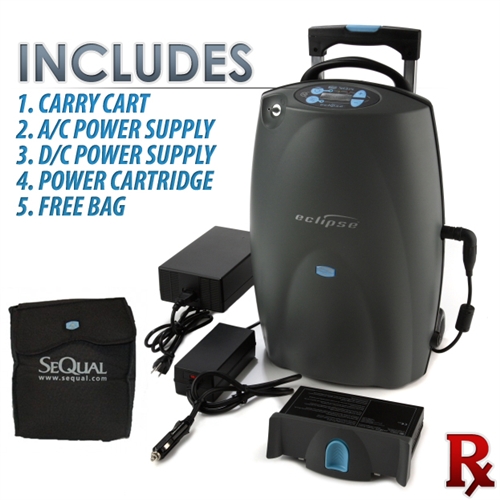
The Eclipse 3 comes complete with a Power Cartridge, AC Power Suppy, DC Power Supply, Universal Cat with Telescoping handle, cannula, as well as, an informative Patient Pack.

YOU HAVE THE FREEDOM TO SIMPLIFY
The AutoSAT feature of the SeQual Eclipse 3 adjusts to your respiratory rate as it increases and decreases. AutoSAT provides you unparalleled performance without limiting available oxygen, enabling the unit to automatically adjust to increased oxygen demands that occur as a part of everyday life.

Experience independence. Now you get to choose how you live and dramatically improve your lifestyle. The SeQual Eclipse 3 eliminates the fear of running out of oxygen giving you peace of mind.

Provides a continuous supply of oxygen by extracting it out of surrounding air Lower electricity bills - uses up to 70% less energy than other stationary concentrators  Reduced noise and heat levels. Produces 3,000 ml of oxygen - 3x more than any other portable device on the market. AutoSAT Technology - pulse delivery system that maintains a consistent bolus size for every breath as your respiratory rate increases and decreases.

YOU HAVE THE FREEDOM TO GO WHERE LIFE TAKES YOU
Life doesn't stop with the prescription of long term oxygen therapy. With the Eclipse 3 you can go...to the store for a last minute purchase, the movies with the grandkids or a road trip across the country.

Life is a series of moments... make the most of yours!

The Eclipse oxygen concentrator can be your 24/7 all-in-one system, whether for day or nocturnal needs. With the power to do continuous flow up to 3 Liters and a max pulse size of 96 milliliters in the pulse setting, the Eclipse 3 can adapt as your oxygen needs progress.

Celebrate. Encourage the greatest quality of life. Whether it's going on a cruise or watching your child get married, the Eclipse 3 allows you to live up to life's potential. You can be spontaneous, flexible and free spirited.

Thursday, May 9, 2013

What Are The Benefits Of Oxygen Therapy With The Respironics Evergo?

Numerous studies have shown that COPD patients who use supplemental oxygen live longer and have more active lives than individuals not receiving oxygen. Oxygen therapy is based on the premise that all human cells require sufficient levels of oxygen to function properly. Exercise is often easier for individuals receiving supplemental oxygen because more oxygen is getting to the muscles. Receiving oxygen from machines like the EverGo also helps to reverse the long-term effects of oxygen deficiency on the heart and reduce sleep disruption while also improving concentration and memory levels. Ask your doctor if oxygen therapy and the Respironics EverGo are right for you
Respironics EverGo Features:
  • FAA Approved Portable O2 device for Air Travel
  • Lightweight design ideal for travel
  • 8 hour battery life from dual rechargeable batteries
  • Easy to use touch screen controls
  • Delivers more oxygen per minute in pulse mode than any other POC
  • Combine with the EverFlow Q Home Oxygen Concentrator for a complete oxygen therapy system
  • Can be charged with a wall outlet or car charger
  • Eliminates the need for costly home oxygen delivery and bulky tanks
  • Oxygen concentrator can be used while charging
  • Easily accessible, washable particle filter
  • Includes rolling cart and car charger for added convenience
  • To see how the Respironics EverGo stacks up against other portable oxygen concentrators, check out our "Portable Oxygen Concentrator Comparison" page!

Respironics EverGo Oxygen Concentrator Specifications:
All purchases of the Respironics EverGo require a prescription for oxygen therapy

The EverGo is only to sold customers in the USA
Works with Oxygen Tubing up to 30 feetOxygen tubing and cannula not included
AC Power UniversalInput: 100-240 VAC, 50-60 Hz, 1.0 Amp;
Output: 18 VDC, 5 Amp
DC Power12-18 VDC, 5 Amp
Power Consumption110 W at 100 VAC (charging),
120 W at 240 VAC (charging); 70 W (not charging)
Oxygen Concentration89% +/- 3%
Oxygen DeliveryPulse Dose Settings 1-6 in 0.5 increments
Weight10 lbs (4.5 kg) with 2 batteries,
8.5 lbs (3.9 kg) with 1 battery
DimensionsLength: 12 in (30.5 cm)
Width: 6 in (15.2 cm)
Height: 8.5 in (21.6 cm)
Battery Duration2 batteries = 8 hours (setting of 2, 20 bpm),
1 battery = 4 hours (setting of 2, 20 bpm)
Sound Level47 dBA typical at a Setting of 2
FiltersGross particle, inlet filter, micro-felt filter (bacteria)
Oxygen Purity AlarmsLow oxygen at 83%
Operating Temperature41F to 104F (5C to 40C)
Storage/Transport Humidit-4F to 140F (-20C to 60C) up to 95% RH non-condensing
Operating HumidityUp to 95% relative humidity
Outlet Pressure3 psi
Operating AltitudeUp to 8000 ft
Alarms and IndicatorsLow battery at 17 minutes life left;
battery status on touch screen and on battery;
no breath alarm after 2 minutes
Oxygen CapacitySimulates up to 6 liters per minute from a continuous flow machine

For more details about this product or to download documents and manuals, go to Evergo by Pulmonarysolutions

Credits to: ActiveForever


Wednesday, April 10, 2013

The Danger of Oxygen Use with Sleep Apnea and COPD


There are situations where the use of oxygen to treat sleep apnea may actually be dangerous. When chronic obstructive pulmonary disease (COPD), such as emphysema, occurs alone, oxygen has been shown to be beneficial. However, when it occurs with obstructive sleep apnea, a different picture emerges.

In this so-called "overlap syndrome," the use of nocturnal oxygen without relief of the airway obstruction can cause worsened breathing overnight. This may result in complaints such as morning headache or confusion. Therefore, it is important that continuous positive airway pressure (CPAP) be used to treat the obstruction, with supplemental oxygen infused into the system as needed to confer the other benefits.

Therefore, it is important that individuals with COPD undergo a sleep study if there is suspicion of sleep apnea contributing to their complaints. And clearly, oxygen alone is not an adequate treatment for those suspected of having sleep apnea.


Thursday, March 28, 2013

How Oxygen Theraphy Works and Help The COPD Patients


What Is Oxygen Therapy?

Oxygen therapy is one of the treatment that provides COPD patients with extra oxygen, a gas that helps the body to work well. Normally, your lungs absorb oxygen from the air. However, some diseases and conditions can prevent you from getting enough oxygen.

Oxygen therapy is a healthy way of keeping the patient from being suffocated because of lack of air while sleeping or a cure to sleeping disorders.

There are different kinds of oxygen therapy that can be recommended by doctor. If you are COPD (Chronic Obstructive Pulmonary Disease) patient you will be recommended with home oxygen or traveling oxygen. For traveling oxygen you can always use the latest additional products like portable oxygen concentrator.

There are many portable oxygen concentrator that can be purchase in the market for a very affordable price but it will depend on the amount of pulse-dose that the patient need. There are new and advance oxygen concentrator that can help on traveling patient like easypulse poc or simplygo portable oxygen concentrator. These two are the newest addition to the list of the most convenient, easy to use oxygen.

For those patient using the home oxygen fill there are also oxygen therapy that might be recommended by doctors. It is time you learned about the UltraFill Home Oxygen System System.

For those who are using the portable oxygen you can learn about SimplyGo or EasyPulse portable oxygen concentrator.

Oxygen therapy introduces substances into the body that are supposed to release oxygen. The extra oxygen is believed to increase the body's ability to destroy disease-causing cells. 

Oxygen Therapy: Safety Precautions You'll Need to Take

Follow these oxygen-therapy safety tips from the U.S. National Library of Medicine:


  • When possible, stay at least 6 feet away from heat sources and open flames when you're using oxygen, or when you're storing tanks.
  • Do not allow smoking in the room where your oxygen-therapy system is located.
  • Keep a fire extinguisher in your home, and make sure your smoke detectors are operational.
  • Do not adjust the flow rate on your oxygen system without your doctor's OK.
  • Keep oxygen tubing less than 50 feet long so you don't dilute the amount of oxygen that reaches your lungs.
  • Ask your oxygen provider how to keep the system clean and free of dust.
  • Do not use extension cords to power your oxygen concentrator.
  • Keep extra charged batteries for your oxygen concentrator.
  • Inform your electric company of your condition so it will prioritize returning power to your home if there is an outage.
  • Keep backup tanks on hand.
  • Store oxygen containers in an upright position in a well-ventilated area. Make sure they're secured so that they don't tip over.
  • Use a carrying case specifically designed for oxygen. It has the required ventilation.
  • Secure extra tubing and cords so that you don't trip over them.
  • Treat oxygen as you would any other prescription drug, because that is exactly what it is. Use only the amount your doctor has prescribed — no more and no less.
Although these safety precautions should be taken seriously, adjusting to supplemental oxygen is not as difficult as it may seem.

Other Source: DoMoreWithOxygen.Com

ShareThis